Well documented. Several independent sources across different periods. In the record from the very beginning.
Montu mnṯw
the destroying heat, absorbed by Thebes
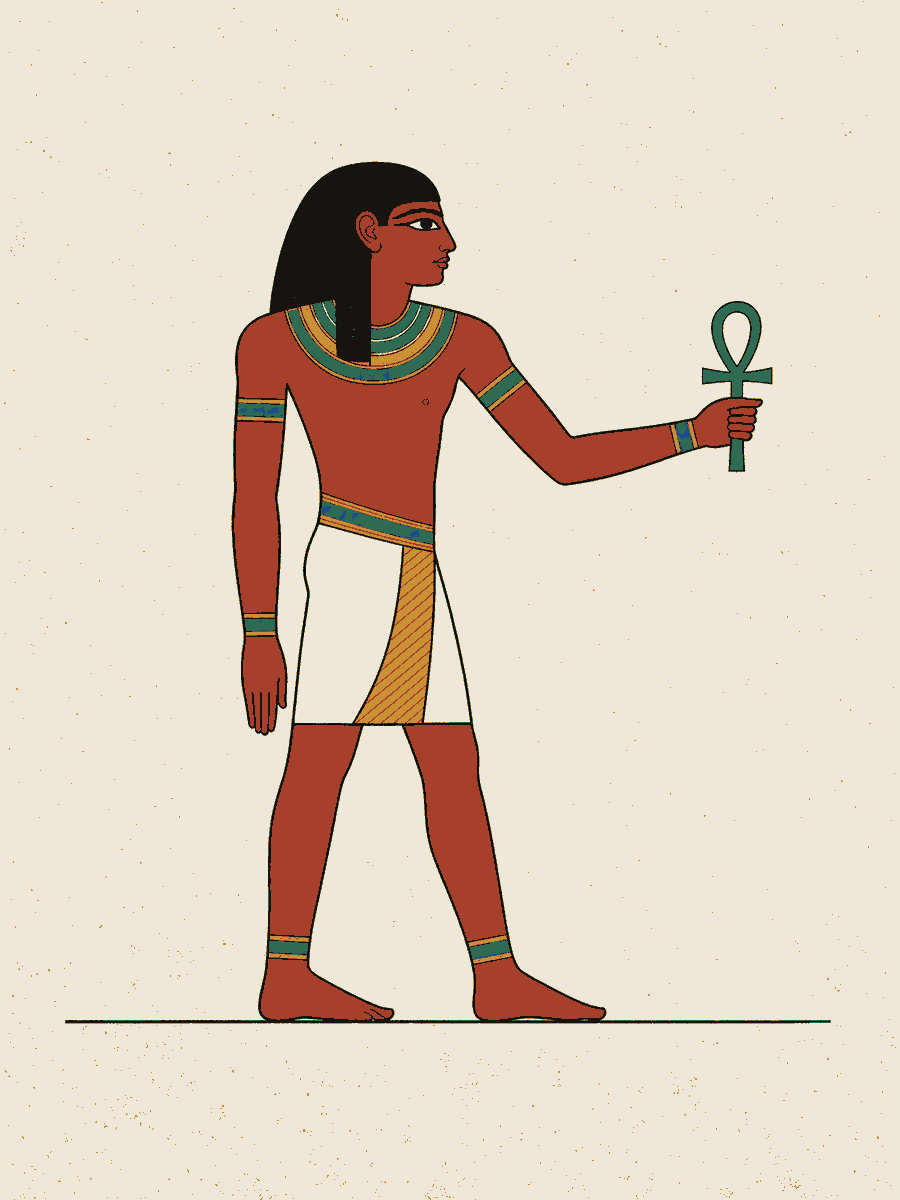
The figure, plainly
The sun that stays too long
A retelling, not a translation. What follows is the story as it is commonly told, drawn together from the better popular and scholarly accounts. It is not keyed to any single ancient text, and the ancient sources rarely agree with each other as neatly as a retelling has to. The attested record — with its sources, its gaps, and its disagreements — is below.
Egyptian solar theology is overwhelmingly about renewal.
Khepri is the sun coming into being, named after a verb for becoming. Ra crosses. Atum completes and begins again. Nut swallows the disc each evening and gives birth to it each morning. The whole apparatus is built around the idea that the light comes back.
Montu is the sun considered as the thing that kills you in a field at noon.
Budge, in one clause: "he appears to have been a personification of the destructive heat of the sun."
Not the light. The heat. The same star, filed under harm.
Why that needed its own god
I think this is a genuinely sophisticated piece of theology and it is easy to walk past.
The sun in Egypt does two incompatible things. It ripens the crop and it kills the traveller. It makes the year work and it makes the desert uninhabitable.
You could fold that contradiction into one deity and let it sit there — plenty of religions do. Egypt instead split it off and gave the dangerous half a separate god with his own city.
Which is the same instinct visible everywhere else in this material: when two things genuinely differ, give them separate names and keep both. Five creation stories. Three ages of Horus. A god of the dark before dawn and a different god of the dark after dusk.
Montu is the sun's other job.
Heliopolis of the South
His real home was not Thebes, despite the title he usually carries.
Budge: "though he was commonly described as 'lord of Thebes,' the chief seat of his worship was at Hermonthis, the Annu-Rest — 'Heliopolis of the South.'"
That place-name is an argument. Annu — Heliopolis — was the seat of Atum and of the oldest solar theology in Egypt, the place whose priests had spent a thousand years establishing that the world began there.
A town in Upper Egypt calling itself the southern Heliopolis is not being modest. It is staking a claim to the sun.
And Thebes had to deal with him
Which brings us to why Montu matters beyond his own cult.
Budge, again with unusual directness:
Menthu was probably an old local god whose cult was sufficiently important to make it necessary for the priests of Amen to incorporate him with the great god of Thebes.
That word — necessary — is the interesting one.
This reference has now watched the priests of Amun do this five separate times. They took Khonsu, an ancient moon god, and made him Amun's son, borrowing an antiquity Amun did not have. They took Mut, whose oldest layer is the counterpart of the primeval water, and made her his wife. They inserted Amun into the Ogdoad of Hermopolis, displacing an existing pair. They borrowed Min's entire body — posture, raised arm, flail and title — whenever Amun needed to be shown as a generative power.
And they incorporated Montu, because he was too important to leave standing outside.
Five acquisitions, and not one of them an invention. Thebes never made anything up. It identified what it lacked and went and got it, from priesthoods that already had it.
He outlasted the takeover
The last detail is a small one that I like.
Among Budge's illustrations is a scene captioned "Menthu giving 'life' to Ptolemy Alexander."
So a thousand years after the priests of Amun absorbed him — after Thebes rose and fell, after Egypt was taken by Persians and then by Macedonians — a Greek king is still being shown receiving life from the god of the burning sun of Hermonthis.
Absorption, in this system, never seems to mean erasure. Montu was incorporated into Amun and went on being Montu. The Ogdoad kept running beside the Ennead. Five cities each went on claiming the world began there.
Egypt did not resolve things. It accumulated them, and everything it had ever believed stayed on the payroll.
Overview
Montu is the sun as something that burns you.
Budge: "he appears to have been a personification of the destructive heat of the sun" [budge-1904]. Not the sun that rises, or crosses, or is reborn — the sun that kills things in a field at midday.
And he is the fifth documented case of Thebes taking over a god it needed.
Attestation history
Old Kingdom. "Menthu is mentioned in the Pyramid Texts (Mer-en-Ra, line 784), together with a number of ancient gods, in such a way that we may be certain that his worship was widespread, even in the VIth Dynasty" [budge-1904]. He appears there alongside Khepera, Nu, Tem and Uash.
Where he actually belonged. "Though he was commonly described as 'lord of Thebes,' the chief seat of his worship was at Hermonthis, the Annu-Rest, i.e., 'Heliopolis of the South,' of the hieroglyphic texts" [budge-1904].
And what Thebes did about it. Budge states the takeover plainly:
Menthu was probably an old local god whose cult was sufficiently important to make it necessary for the priests of Amen to incorporate him with the great god of Thebes. [budge-1904]
His titles. "Menthu-Ra, lord of Thebes, King of the gods, he who is on his throne in Aptet, Merti, mighty one of two-fold strength, lord of Thebes of the North, Sma-taui, Governor of Behutet, lord of Annu of the South, prince of Annu of the North" — and "lord of Manu," the Libyan mountain [budge-1904].
Where he was worshipped. Annu of the South (Hermonthis), Thebes, Annu of the North, Tchertet (Edfu), Dendera, and possibly the First Cataract temples [budge-1904].
Still current under the Ptolemies. One of Budge's illustrations is "Menthu giving 'life' to Ptolemy Alexander" [budge-1904].
What the texts say
"Heliopolis of the South" is the whole story in a place-name. Hermonthis was called Annu-Rest — the southern counterpart of Annu, Heliopolis, seat of Atum and of the oldest solar theology in Egypt.
A town claiming to be the southern Heliopolis is claiming solar primacy for its own god. Which makes Montu a rival to the Heliopolitan sun before he is anything else, and explains why he mattered enough for Thebes to bother with him.
The fifth Theban acquisition, and the most explicit. This corpus has now watched the priests of Amun do the same thing five times:
1. Khonsu — an ancient moon god made Amun's son, borrowing an antiquity Amun lacked. 2. Mut — a goddess whose oldest layer is the counterpart of the primeval water, made his consort. 3. The Ogdoad — Amun inserted into the Hermopolitan eight, displacing a pair. 4. Min — his ithyphallic body and the title Fa-a borrowed wholesale for Amen-Ra as a generative power. 5. Montu — "incorporated" because his cult was too important to leave outside.
Budge's verb is the useful one: necessary. Not desirable — necessary. Thebes did not absorb gods out of appetite; it absorbed the ones it could not afford to have standing separately.
A sun god of harm. Egypt's solar theology is mostly about renewal — Khepri becoming, Ra crossing, Atum completing. Montu is the same star considered as a weapon, which is why he ends up a war god. The heat that ripens the crop is the heat that kills the traveller, and Egypt gave the second aspect its own deity rather than folding it into the first.
Iconography
Budge reproduces "Menthu, lord of Thebes" and "Menthu giving 'life' to Ptolemy Alexander" but the archived text does not describe the figure. The familiar image — falcon-headed, with a solar disk and two tall plumes — is not in any archived source here.
Cult and practice
Hermonthis above all, as Annu-Rest. Then Thebes, Annu of the North, Edfu, Dendera, and perhaps the First Cataract. Still receiving royal attention under the Ptolemies.
The record
Every claim above traces to a row here. Source, exact place in that source, and what it actually supports.
| Source | Locus | Attests |
|---|---|---|
[budge-1904] | *Gods of the Egyptians* II, citing Mer-en-Ra l. 784 | Menthu in the Pyramid Texts with Khepera, Nu, Tem and Uash; worship widespread by the VIth Dynasty |
[budge-1904] | same | chief seat at Hermonthis, the *Annu-Rest* or "Heliopolis of the South" |
[budge-1904] | same | "necessary for the priests of Amen to incorporate him with the great god of Thebes" |
[budge-1904] | same | "a personification of the destructive heat of the sun" |
[budge-1904] | same | the full titulary, including "lord of Manu," the Libyan mountain |
[budge-1904] | plates | "Menthu, lord of Thebes"; "Menthu giving 'life' to Ptolemy Alexander" |
Sources
[budge-1904]— Budge, The Gods of the Egyptians (1904), vol. II. Public domain, archived insources-texts/. Budge caveat applies (04-BIBLIOGRAPHY.md).[sethe-1908]— Sethe, Die altägyptischen Pyramidentexte (1908–22). Public domain.[wilkinson-2003]— Wilkinson, The Complete Gods and Goddesses. In copyright; cited only.
Open questions
- Get his iconography from a source. The falcon head with disk and plumes is standard in modern accounts and appears nowhere in the archived text — only two undescribed plates.
- Verify Mer-en-Ra 784 against Sethe. It is the entry's only dated locus and carries the Old Kingdom badge.
- Establish when the Theban incorporation happened, with a dated text. Budge asserts the manoeuvre without dating it, and a date would let the five acquisitions be put in sequence.
- Identify Uash, named beside Montu in the Pyramid Text list and otherwise untraced here.
- Get the Hermonthis (Armant) excavation record; Annu-Rest as a rival Heliopolis is a substantial claim resting on a place-name.
- Establish the relationship between Montu the solar heat and Montu the war god — the archived sources give the first and imply the second without connecting them.
Cite this entry
Research grade: ●full — Multiple attestations across periods.
"Montu", The Egyptian God Corpus,
       graded full, retrieved 2026-08-10.