Well documented. Several independent sources across different periods.
Apis ḥp
the bull identified by its markings

The figure, plainly
The god you had to go and find
A retelling, not a translation. What follows is the story as it is commonly told, drawn together from the better popular and scholarly accounts. It is not keyed to any single ancient text, and the ancient sources rarely agree with each other as neatly as a retelling has to. The attested record — with its sources, its gaps, and its disagreements — is below.
Almost every deity in this reference is an image, a name, or a text.
Apis was an animal. A specific bull, alive, in a building at Memphis, that you could walk in and look at.
And when he died, somebody had to go out and find the next one.
The specification
This is the part that stops me. Apis was not chosen by a priest's vision or by lot. He was identified by markings, and the list is precise.
From the classical accounts Budge quotes, the calf:
- is black
- has a square spot of white on the forehead
- has, on its back, the figure of an eagle
- has double hairs in the tail
- has a beetle on the tongue
Pliny adds a crescent-shaped white patch on the right flank.
That is not a description of a god. It is a checklist. Somebody had to walk into a field, look at a calf, and work through it — forehead, back, tail, and then open the animal's mouth and check under the tongue.
The god was not represented. The god was identified.
They kept a spare
Here is Budge being sharper than he usually is.
Pliny records that when an Apis died, "a general mourning ensued, and the priests and others went with their heads shaven until they found a successor" — and then notes that this did not take long.
Budge draws the obvious inference: "we may therefore assume that an Apis was generally kept in reserve."
Think about what that means operationally. While the living god was in his chamber at Memphis being consulted, somebody elsewhere was already checking calves against the list. A shortlist. A continuity plan.
And they drowned him
The bull did not die of old age.
Pliny again: "when the animal had lived a certain number of years, it was destroyed by being drowned in the fountain of the priests."
A fixed term, then a killing, then public mourning with shaved heads, then a successor who had probably already been located.
I want to be careful here — this rests on a Roman source describing somebody else's religion, and it may be wrong. But if it is right, it fits everything else in this material. Nothing in Egyptian religion is finished and left alone. The sun is rowed across the sky every night. Order is propped up nightly by gods who cannot leave. The serpent is killed again tomorrow.
The living god is replaced on schedule, and even that is maintenance.
How the oracle worked
At Memphis he had two bed-chambers, and people came to learn the future.
The mechanism was this: the bull walked into one room or the other. One meant yes, the other meant no.
He also answered by taking food from your hand — or declining to.
There is no priest interpreting entrails, no ambiguous verse to be argued over. It is binary, public, and performed by an animal with no interest in the outcome. You asked, and you watched which door he went through.
I find that a more honest oracle than most.
His public life
He was normally kept in seclusion. When he did come out, he was escorted by a crowd of boys singing hymns.
Once a year a cow was presented to him — "but it is said that she was always killed the same day that they found her."
His birthday was a seven-day festival, and during it, according to the accounts, no man was ever attacked by a crocodile.
And in a courtyard in front of his sanctuary there was a second, smaller sanctuary — for his mother. He was let out into that courtyard so people could see him.
He was already Osiris
The last thing, and it is where he stops being a curiosity and becomes theologically serious.
By the Eighteenth Dynasty — a thousand years before any Ptolemy — the priests of Memphis had already joined Apis to Osiris. The stelae from the Serapeum call him "the life of Osiris," and Apis-Osiris "the great god, Khent Amentet, the lord of life for ever."
Budge's conclusion: by the beginning of the New Empire, Apis was recognised as a god of the Underworld.
So the arrangement is this. A living bull, replaced on a schedule, who at the moment of his death becomes the god of the dead. The living form and the dead form of one deity, alternating, with a checklist to find the next one.
Which is, when you put it that way, exactly the relationship between a pharaoh and Osiris — and it is where Serapis comes from.
Overview
Apis is not a statue or a story. Apis is an actual bull, alive, in a building at Memphis, identified by a checklist of markings and consulted for oracles.
When he died another was found, because the marks told you which calf was the next one.
Attestation history
The marks. Budge quotes the classical description: the calf "is black, and has a square spot of white on the forehead; and on the back the figure of an eagle: and in the tail double hairs: and on the tongue a beetle" [classical].
Pliny adds "a conspicuous white spot on the right side, in the form of a crescent" [classical].
How he was conceived. He is "the calf of a cow which is incapable of conceiving another offspring," and "the Egyptians say that lightning descends upon the cow from heaven, and that from thence it brings forth Apis" [classical].
Joined to Osiris very early. The Serapeum stelae call Apis "the life of Osiris, the lord of heaven, Tem [with] his horns [in] his head," and Apis-Osiris "the great god, Khent Amentet, the lord of life for ever." Budge dates that text to the XVIIIth Dynasty, concluding that "even at the beginning of the New Empire Apis and Osiris were joined together by the priests of Memphis, and… he was at that time recognized as a god of the Underworld" [budge-1904].
And to Ptah. On a XIXth Dynasty monument Apis is "the renewed life of Ptah"; by the XXVIth he is called "the second Ptah" [budge-1904].
What happened to him. Pliny: "when the animal had lived a certain number of years, it was destroyed by being drowned in the fountain of the priests. A general mourning ensued upon this, and the priests and others went with their heads shaven until they found a successor" [classical].
Budge draws the inference: the search "did not take long, and we may therefore assume that an Apis was generally kept in reserve."
How the oracle worked. At Memphis there were "two Thalami set apart for him; to these bed-chambers the people were wont to resort to learn the auguries, and according as Apis entered the one or the other of these places, the augury was deemed favourable or unfavourable. He gave answers to its devotees by taking food from the hands of those who consulted him" [classical].
His public life. "Usually Apis was kept in seclusion, but whensoever he appeared in public he was attended by a crowd of boys who sang hymns to him." Once a year a cow was presented to him, "but it is said that she was always killed the same day that they found her." His birthday was marked by "an annual festival which lasted seven days, and during this period no man was ever attacked by a crocodile" [classical].
Strabo records a courtyard before his sanctuary containing "another sanctuary for the dam of the god," where he was turned loose to be seen [classical].
What the texts say
The theology is a specification. Black; white square on the forehead; an eagle shape on the back; double hairs in the tail; a beetle under the tongue; a crescent on the right flank.
That is not a description of a god. It is a set of acceptance criteria — a way of determining, from a field of candidate calves, which one is the deity. Egyptian religion usually asks you to recognise a god from an image; this one asks you to identify one from an animal population.
The oracle is behavioural, and honest about being so. Two rooms, and the god answers by choosing which to walk into. Or by eating from your hand, or not.
There is no priest interpreting. The mechanism is binary and public, and either the bull does the thing or he does not.
They kept a spare. Budge's inference from the speed of the succession is the sharpest observation in the whole account. If the replacement was always found quickly, somebody was looking in advance — which means the marks were being checked against calves across Egypt while the current god was still alive.
Did they drown him? The recorded lifespans say probably not.
Pliny's claim is that the bull was killed after "a certain number of years" — a fixed term. Mariette's epitaphs give each animal's life "in years, months and days," which makes that checkable.
Searching the archived volume for the pattern returns two complete lifespans:
| Lifespan | |
|---|---|
| 1 | 16 years, 7 months, 17 days |
| 2 | 17 years, 6 months, 5 days |
They differ by nearly a year, and neither is a round figure. That is not what a fixed ritual term looks like; it is what natural lifespans look like, recorded to the day.
Two data points is a thin sample and the check is not conclusive. The volume archived here appears to contain only part of the epitaph catalogue — sixty-four bulls are discussed but only two full lifespans are recoverable from this text, which suggests the detailed register is in a companion volume. But on the evidence available, Pliny's ritual drowning is not supported, and the burden now sits with it.
What the classical account may be describing. The bull did not die of old age according to Pliny. After a set term the priests killed him, and mourned.
That fits the corpus's recurring theme exactly: nothing in Egyptian religion is finished and left alone. The sun is rowed nightly, Maat is propped up nightly, Apophis is defeated nightly — and the living god is replaced on schedule.
Then he becomes Osiris. Which is where Serapis begins.
Iconography
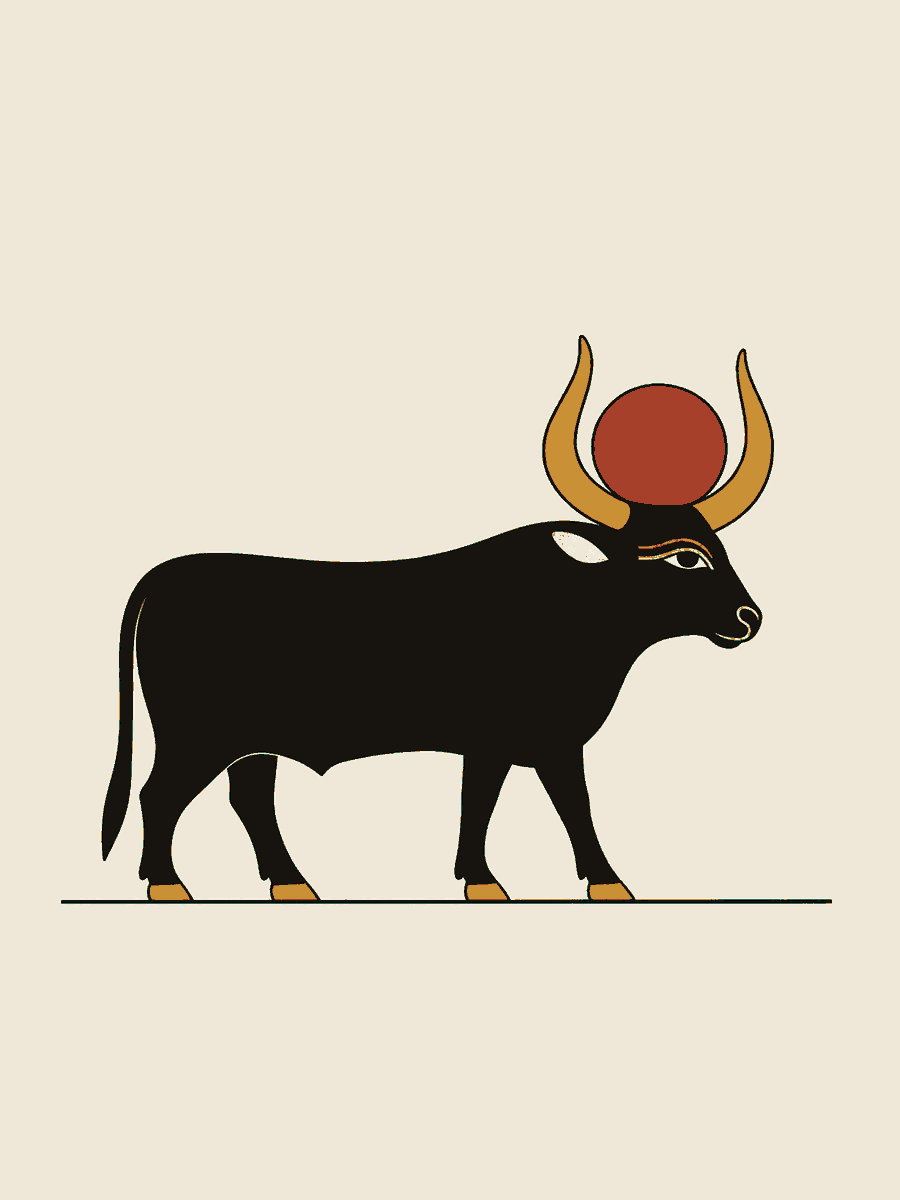
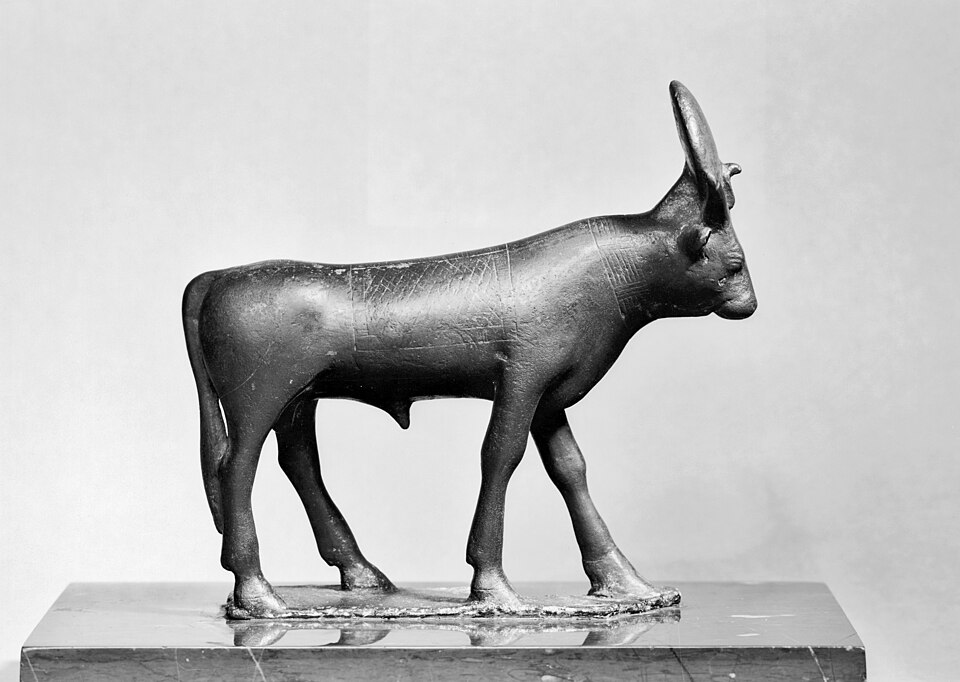
A living bull with the prescribed markings. In art, a bull with a disk between its horns, or bull-headed.
Cult and practice
Memphis — the bull's quarters, the two oracle-chambers, the courtyard with his mother's sanctuary, the seven-day birthday festival. And the Serapeum at Saqqara, where the mummified bulls were buried in succession.
What the excavation found
Mariette dug the Serapeum at Saqqara and published the results in 1882. It supplies what the classical authors cannot: the Egyptian record of the cult as an institution.
Every bull has a dated epitaph. The stelae from the vaults "are all epitaphs," and each records, in Mariette's list: the date of the Apis's birth; the date of his enthronement in the temple of Ptah at Memphis; the date of his death; the date of his funeral; and the total duration of his life in years, months and days [mariette-1882].
Five dates and a lifespan, for each animal. This is not mythology — it is a register.
Sixty-four bulls. Mariette recovered "les soixante-quatre Apis dont l'existence a été jusqu'ici constatée" — the sixty-four whose existence had so far been established [mariette-1882].
He is careful about what that number is not. It is not the number that existed; his classification is "neither definitive nor absolute"; some burials "may have totally disappeared, or else totally escaped me." He says so explicitly so that nobody mistakes his arrangement for a straightforward reading of mummies in the order they lay.
The span of the vaults. The bulls he found are those who came to rest there "from the foundation of the tomb under Amenophis III until its destruction under Theodosius" [mariette-1882] — roughly the fourteenth century BC to the fourth century AD.
And the cult is older than the tomb. Mariette notes that the Apis cult "était debout sous la V° dynastie" — standing under the Fifth Dynasty — and that those early bulls "must have had their own Serapeum, which is not at all ours" [mariette-1882].
Who buried them. The kings named in the official inscriptions of one vault are Psammetichus I, Necho, Apries, Amasis, Cambyses, Darius I, Ptolemy Philometor and Ptolemy Euergetes II [mariette-1882]. The oldest stele records that the tomb was begun by Psammetichus I in year 52 of his reign.
Note the names in that list. Cambyses — the Persian conqueror — and Darius I appear among the kings who buried Apis bulls, and Mariette records a granite sarcophagus "inscribed with the name of Cambyses" blocking one of the entrances.
Plutarch, at first hand
The classical material on this page was held at second hand through Budge while Plutarch sat in sources-texts/ (C388, C391). Three passages are worth having in his own words.
They kept him off the Nile.
It is said also that they water the Apis from a well of his own, and keep him away from the Nile altogether, not that they think the water unclean because of the crocodile, as some believe; for there is nothing which the Egyptians hold in such honour as the Nile. But the drinking of the Nile water is reputed to be fattening and to cause obesity. They do not want Apis to be in this condition [plutarch]
A dedicated well, and a diet. This is husbandry, not theology, and it is the most concrete thing in the archive about the daily management of a living god — a priesthood keeping the sacred bull off the country's own water supply so he would not put on weight.
Killing him was a political act, and Egypt kept the grudge.
So also Ochus, the most cruel and terrible of the Persian kings, who put many to death and finally slaughtered the Apis and ate him for dinner in the company of his friends, the Egyptians called the "Sword"; and they call him by that name even to this day in their list of kings. [plutarch]
In their list of kings. The insult was not a story told about Artaxerxes III — it was entered in the official record and was still there four hundred years later when Plutarch wrote. Compare the tradition that Cambyses stabbed the Apis, discussed above: two Persian kings, two bull-killings, and one of them permanently renamed in an Egyptian document.
And the theology, from the priests themselves.
Most of the priests say that Osiris and Apis are conjoined into one, thus explaining to us and informing us that we must regard Apis as the bodily image of the soul of Osiris. [plutarch]
That is the Osiris-Apis doctrine stated by Egyptian clergy rather than reconstructed from the name, and it is the hinge of serapis. The bull is the body; Osiris is the soul.
Plutarch also records, in order to dismiss it, Phylarchus's claim that Dionysus brought two bulls from India, one named Apis and the other Osiris [plutarch] — a reminder that the ancient sources on this cult include plain nonsense, and that Plutarch could tell.
Herodotus, at first hand — and the book that is not here
This entry's classical group named Herodotus, and Herodotus is archived. Read at first hand the result is two real gains and one important limit (C392).
The gap, and its closing
Until 2026-07-30 this section recorded a limit. The archived volume was An Account of Egypt — Herodotus Book II only — and the material Budge draws on for this entry (the markings in detail, the oracle, Cambyses stabbing the bull) is all in Book III.
Herodotus had said so himself. Describing the inspection of bulls he writes that the priest checks whether the animal is clean
in respect of the appointed signs, which I shall tell of in another part of the history [herodotus-ii]
The source named its own gap — C390 in a new shape: not the wrong edition, the wrong book of the same work. Book III is now archived [herodotus-iii], and everything deferred is below.
The markings, at first hand
Herodotus gives the checklist he promised, and it is a checklist:
Now this Apis-Epaphos is a calf born of a cow who after this is not permitted to conceive any other offspring; and the Egyptians say that a flash of light comes down from heaven upon this cow, and of this she produces Apis. This calf which is called Apis is black and has the following signs, namely a white square upon the forehead, and on the back the likeness of an eagle, and in the tail the hairs are double, and on the tongue there is a mark like a beetle. [herodotus-iii]
Black, a white square, an eagle, doubled tail-hairs, a beetle on the tongue. Five conditions, four of them requiring you to handle the animal — you cannot check the tongue or the tail of a bull from a distance.
And the mother is retired. She bears Apis and is never bred again, which makes the god's appearance a terminal event for one cow and explains why the bull "appeared at intervals of long time" rather than being produced on demand.
The conception is by light from the sky. Compare Plutarch above, who reports the same and adds the moon; the two classical witnesses agree independently.
Cambyses, and the stroke in the thigh
The most famous episode about Apis is now readable in full, and it is not what the summaries suggest.
Cambyses returns to Memphis having lost most of his army in Ethiopia, and finds the city celebrating. He assumes they are laughing at him.
Cambyses accordingly seeing the Egyptians doing thus, and supposing that they were certainly acting so by way of rejoicing because he had fared ill… asked them why when he was at Memphis on the former occasion, the Egyptians were doing nothing of this kind. [herodotus-iii]
They tell him a god has appeared. He calls them liars and executes them. He asks the priests; they say the same; he demands the god be brought.
Cambyses being somewhat affected with madness drew his dagger, and aiming at the belly of Apis, struck his thigh: then he laughed and said to the priests: "O ye wretched creatures, are gods born such as this, with blood and flesh, and sensible of the stroke of iron weapons?" [herodotus-iii]
He misses. He aims at the belly and hits the thigh — Herodotus records the error, and it is the detail that makes the scene a scene rather than a moral.
Apis wounded by the stroke in his thigh lay dying in the temple. … Him, when he had brought his life to an end by reason of the wound, the priests buried without the knowledge of Cambyses. [herodotus-iii]
The priests buried the god in secret, which is exactly the behaviour the Serapeum's sealed galleries record archaeologically — and this entry has already noted a stela "inscribed with the name of Cambyses" in that excavation.
And the consequence, given as Egyptian testimony rather than as Herodotus's own view:
Cambyses, as the Egyptians say, immediately after this evil deed became absolutely mad, not having been really in his right senses even before that time. [herodotus-iii]
"As the Egyptians say" — and then Herodotus immediately undercuts it: not having been really in his right senses even before that time. He reports the causal claim and declines it in the same sentence. The corpus keeps both halves.
The court that Psammetichos built
Having thus got power over all Egypt, Psammetichos made for Hephaistos that gateway of the temple at Memphis which is turned towards the South Wind; and he built a court for Apis, in which Apis is kept when he appears, opposite to the gateway of the temple, surrounded all with pillars and covered with figures; and instead of columns there stand to support the roof of the court colossal statues twelve cubits high. Now Apis is in the tongue of the Hellenes Epaphos. [herodotus-ii]
This is the best thing Book II has for this page, and it is worth more than a description would be. It is dated and attributed: Psammetichos I, Twenty-sixth Dynasty, seventh century BC, named as the builder, with the structure placed relative to the Ptah temple gateway.
"In which Apis is kept when he appears" is also precise in a way that matters. Not where Apis lives — where he is kept when he appears, which is the language of an animal that has to be found, recognised and installed. The building is the receiving end of the search.
And the equation Apis = Epaphos is given directly rather than through Budge.
How you tell a bull is clean
Herodotus describes an inspection, and although it is not the search for the Apis, it is the closest thing in the archive to the Egyptian practice of reading a bull's body:
The males of the ox kind they consider to belong to Epaphos, and on account of him they test them in the following manner: — If the priest sees one single black hair upon the beast he counts it not clean for sacrifice; and one of the priests who is appointed for the purpose makes investigation of these matters, both when the beast is standing upright and when it is lying on its back, drawing out its tongue moreover… he looks also at the hairs of the tail to see if it has them growing in a natural manner; and if it be clean in respect of all these things, he marks it with a piece of papyrus, rolling this round the horns, and then when he has plastered sealing-earth over it he sets upon it the seal of his signet-ring… But for one who sacrifices a beast not sealed the penalty appointed is death. [herodotus-ii]
A licensed inspector, a full physical examination — standing, on its back, tongue out, tail checked — and then a sealed papyrus band round the horns, with a capital penalty for using an unsealed animal. That is not religion in the vague sense; it is a certification regime with an inspector, a document, a seal and a criminal sanction.
Keep the two examinations apart
This is the inspection of bulls for sacrifice, not the search for the Apis. The procedures resemble each other — a body read for marks by a specialist — and the entry does not merge them. Budge cites Herodotus for "the markings" of the Apis; what Book II actually contains is a purity test for ordinary sacrificial cattle, whose disqualifying sign (one black hair) is the opposite of the Apis criteria, which require specific black markings. A resemblance is a lead, not an answer (C381).
And a name that is not the bull
Herodotus also mentions the city of Apis, in the Libyan borderlands, whose people petitioned the oracle of Ammon to be excused Egyptian religious rules — "because they desired not to be debarred from the use of cows' flesh" — and were refused [herodotus-ii].
A place called Apis, in a passage about eating beef. Four occurrences of the word in Book II and one of them is a town; anyone searching this text by name should know that before counting hits.
The record
Every claim above traces to a row here. Source, exact place in that source, and what it actually supports.
| Source | Locus | Attests |
|---|---|---|
[classical] | Herodotus / Aelian, via Budge | the marks: black, white square on the forehead, eagle on the back, double tail hairs, beetle on the tongue |
[classical] | Pliny, *Nat. Hist.* viii. 72 | the crescent-shaped white spot; drowning in the fountain of the priests; the shaven-headed mourning |
[classical] | via Budge | the two Thalami and the binary augury; answering by taking food from the hand |
[classical] | Strabo xvii. 31 | the courtyard sanctuary for the dam of the god |
[classical] | via Budge | the seven-day birthday festival; no man attacked by a crocodile during it |
[budge-1904] | Serapeum stelae, XVIIIth Dynasty | "the life of Osiris"; Apis-Osiris as "Khent Amentet, the lord of life for ever" |
[budge-1904] | XIXth and XXVIth Dynasty monuments | "the renewed life of Ptah"; "the second Ptah" |
[herodotus-iii] | *The History* III. 28 | the markings in full — **black**, **a white square on the forehead**, **the likeness of an eagle on the back**, **doubled hairs in the tail**, **a mark like a beetle on the tongue** |
[herodotus-iii] | *ibid.* III. 28 | conception by **a flash of light from heaven** upon the cow, who **is never permitted to conceive again** |
[herodotus-iii] | *ibid.* III. 27–29 | **Cambyses** mistakes the festival for mockery, executes the officers and priests, **aims at the belly and strikes the thigh**, and mocks a god "**with blood and flesh, and sensible of the stroke of iron weapons**" |
[herodotus-iii] | *ibid.* III. 29–30 | Apis **dies of the wound**; **the priests bury him without Cambyses' knowledge**; Cambyses "**as the Egyptians say**" goes mad — **and Herodotus doubts it in the same sentence** |
[herodotus-iii] | *ibid.* III. 27 | Apis "**wont to appear at intervals of long time**" |
Sources
[budge-1904]— Budge, The Gods of the Egyptians (1904), vol. II, ch. XII "Asar-Hapi or Serapis" and the sacred-animals chapter. Public domain, archived insources-texts/. Budge caveat applies (04-BIBLIOGRAPHY.md).[plutarch]— Plutarch, De Iside et Osiride, trans. Babbitt (Loeb). Public domain, archived asplutarch-de-iside-et-osiride-babbitt-loeb.txt. Corrected 2026-07-30 — previously cited through Budge and described as unavailable while the archive held it (C391).[classical]— Aelian (De Natura Animalium xi. 10), Pliny (Nat. Hist. viii. 72), Strabo (xvii. 31) and Diodorus (i. 85), cited by Budge at second hand and genuinely not archived here. Greek and Roman observers of a foreign cult — good on procedure, unreliable on meaning. The two members of the old[classical]group that are on disk now have bullets of their own, above.[herodotus-ii]— Herodotus, An Account of Egypt (Book II only), trans. Macaulay. Public domain, archived. Supplies the Psammetichos court, the Greek equation with Epaphos, and the sacrificial-bull inspection. Defers the signs to "another part of the history" — which is Book III, now archived below.[herodotus-iii]— Herodotus, The History, Book III (Thaleia), trans. G. C. Macaulay. Public domain, archived 2026-07-30, closing C392. Extracted from the Gutenberg volume without Books I–II, because Book II is already held separately and archiving it twice would double every hit drawn from it (C384). Supplies the markings, the conception, the oracle interval, and the Cambyses episode entire.[mariette]— Mariette, Le Sérapéum de Memphis (1882). Public domain, archived asmariette-1882-serapeum-de-memphis-fr-ocr.txt. Corrected 2026-07-30: the open thread below recorded this closed on 2026-07-29 and the source line still called it unavailable — the entry contradicted itself and nothing checked (C391).[wilkinson-2003]— Wilkinson, The Complete Gods and Goddesses. In copyright; cited only.
Open questions
- ~~Get Mariette's Sérapéum de Memphis~~ — closed 2026-07-29: archived as
[mariette-1882], and it supplied the epitaph structure, the sixty-four bulls, the span of the vaults and the royal names. - The classical material is now partly verified at first hand. Plutarch is done (the well, Ochus, the priests' doctrine). Herodotus is archived and still unread for this entry — do that next; he is the earliest of the group and the likeliest source for the markings. Aelian, Pliny, Strabo and Diodorus remain genuinely unarchived, and the markings, the oracle mechanism and the drowning still rest on them.
- ~~Read Herodotus II on Apis.~~ Done 2026-07-30. Yielded the Psammetichos court, Epaphos, and the inspection-and-sealing procedure.
- Archive Herodotus Book III. This is now the single highest-value acquisition for this entry: it holds the Apis markings, the oracle, and Cambyses, all three of which this page currently rests on Budge for. Herodotus points at it himself.
- Did Psammetichos' court survive? A named Twenty-sixth Dynasty structure at Memphis, opposite the Ptah temple's south gateway, with twelve-cubit colossi for columns. Mariette dug at Memphis; check whether the court is in the archived Serapeum volume.
- ~~Test the drowning against the epitaphs~~ — partially answered 2026-07-29: the two complete lifespans recoverable from the archived volume are 16y 7m 17d and 17y 6m 5d. They differ, and neither is round. Pliny's fixed term is not supported, on a sample of two.
- Get the rest of the epitaph catalogue. Only two full lifespans appear in the archived volume despite sixty-four bulls being discussed — the detailed register is presumably in a companion volume of Mariette's publication. A full run of sixty-four dated lifespans would settle the drowning question outright and would be the most concrete dataset in the reference.
- Reconcile the classical tradition that Cambyses stabbed the Apis bull with Mariette's finding that a granite sarcophagus inscribed with Cambyses' name blocks one of the vault entrances, and that he is named among the kings who buried Apis bulls.
- Verify the marks against an Egyptian text rather than a Greek one. If no Egyptian source lists them, that is itself a finding.
- Establish whether the drowning is real or a Roman misunderstanding. It is a strong claim resting on Pliny alone.
- Date the start of the cult. Budge says "very early in the dynastic period" without a citation.
- Record the third Hapi collision in
05-TRANSLITERATION.md— the bull, the Nile-god, and the son of Horus.
Cite this entry
Research grade: ●full — Multiple attestations across periods.
"Apis", The Egyptian God Corpus,
       graded full, retrieved 2026-08-10.