Well documented. Several independent sources across different periods. In the record from the very beginning.
Osiris wsjr
lord of the dead and foremost of the westerners


The myth, retold
The story as it is told
A retelling, not a translation. What follows is the story as it is commonly told, drawn together from the better popular and scholarly accounts. It is not keyed to any single ancient text, and the ancient sources rarely agree with each other as neatly as a retelling has to. The attested record — with its sources, its gaps, and its disagreements — is below.
Osiris was a king, and his brother killed him for the throne.
That is where every version starts, and it is worth sitting with how ordinary it is. Not a war in heaven, not a rebellion of the damned — a succession dispute. One brother wanted what the other had.
The murder
Set invites Osiris to a feast. There is a beautiful chest, made to a secret measurement, and Set offers it to whichever guest fits it exactly. Everyone tries. Osiris climbs in, because of course he does — it was built to his body. The lid goes down, the seams are sealed, and the chest goes into the Nile.
Later, when Isis has recovered the body, Set finds it again and takes no chances. He cuts his brother into pieces and scatters them the length of Egypt.
You should know that this is Plutarch's version, written in Greek, around a hundred years into the Roman empire — something like two and a half thousand years after Osiris first appears in Egyptian writing. The Egyptians themselves almost never tell it straight through. Their texts allude: they mention the water, the scattering, the grief, and move on, the way you would reference a story everyone in the room already knows. The connected narrative we all repeat was written down by a Greek priest, very late, and it is the version that survived.
The search
Isis looks for him. She finds the pieces — most of them — and puts him back together. This is the part the Egyptians do dwell on, because it is the part that matters: the reassembly, the wrapping, the rites said over the body. Every mummification afterwards is a repetition of what was done for Osiris, and every dead Egyptian is, in the funeral texts, addressed as Osiris. Osiris Ani. Osiris Nebseni. You take his name because you are hoping for his outcome.
And then she conceives a son from him. After his death. That detail is not incidental — it is the entire point of the arrangement. What is dead produces what is living.
He does not come back
Here is where the story refuses to do what you expect.
Osiris is restored, and he does not return to his throne. He does not walk back into Egypt and resume being king. He goes down instead, and stays there, and becomes the ruler and judge of the dead — a different office, permanently held. His son Horus takes the living kingship and fights Set for eighty years to keep it.
So this is not a resurrection story in the sense most people arrive expecting. Nobody gets their old life back. What Osiris gets is a continuation, in a different place, under different terms. And that, it turns out, is the thing on offer to everyone else too. Not a return. A continuation.
Green skin, and a god you could grow
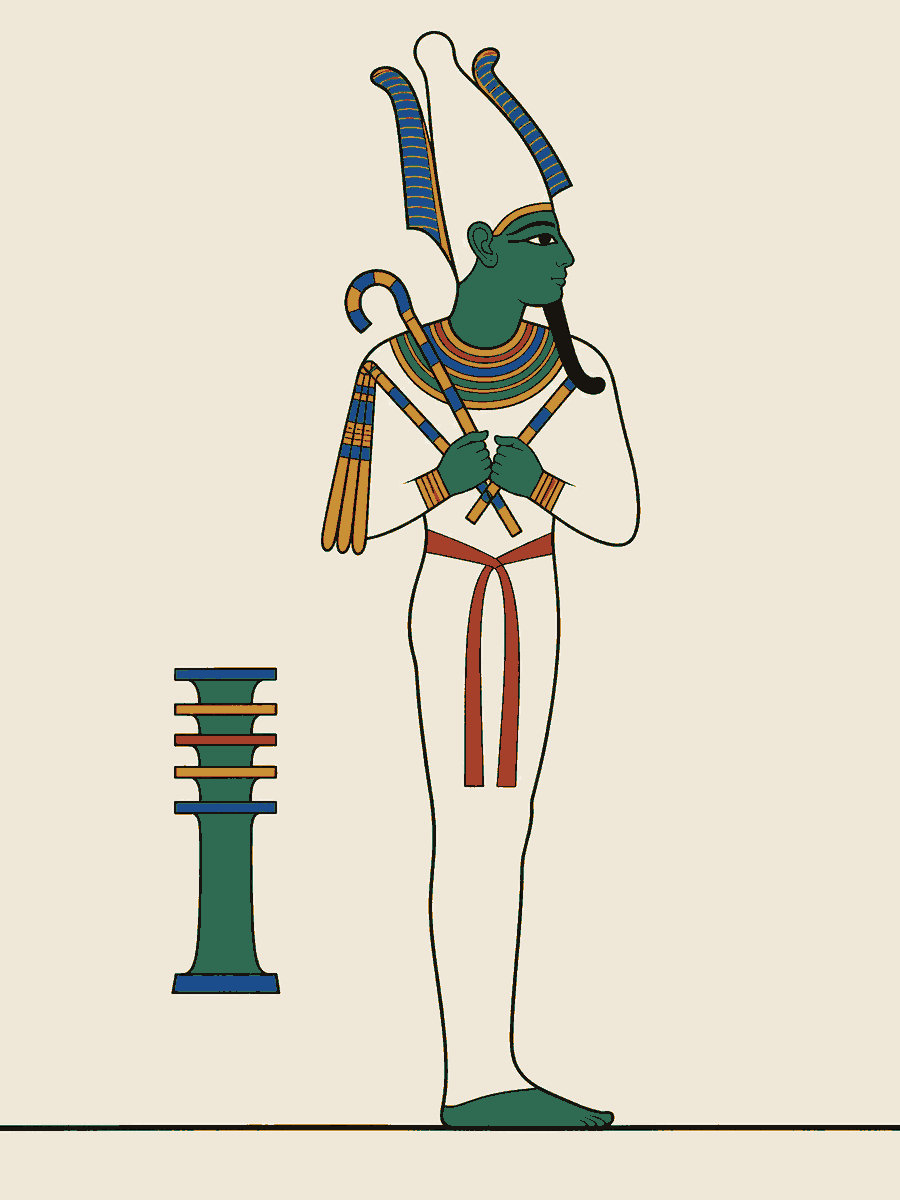
He is usually painted green, sometimes black. Neither means decay. Green is new growth; black is the silt the flood leaves behind, the richest soil in the world. They are both colours of things about to become fertile.
Egyptians took that literally. At the Khoiak festival they made corn mummies — a wooden or cloth frame in the shape of Osiris, packed with soil and barley, watered, and left in the dark. After a few days the god sprouted. Some of these survive in museums, still shaped like a man, the grain long dead now but the intent perfectly legible.
It is hard to think of a more direct piece of religious symbolism anywhere. You want to know what happens to a dead thing put in the ground? Here. Water it.
Why he mattered so much
In the beginning this was royal property. In the Old Kingdom, to become Osiris after death was a thing that happened to kings, and only kings.
By the Middle Kingdom it had spread — down through the officials, then to anyone who could afford a decorated coffin and the spells to go in it. You can watch it happen in the archaeology, which is rare and rather wonderful: a religious idea moving through a society, class by class, over centuries, until a carpenter in Thebes is buried with the same claim a pharaoh once made alone.
The god at the centre of it is a murdered man who was put back together by someone who loved him, and who now runs the place everyone is going.
Overview
Osiris is a murdered king who does not come back to life so much as come back to office. Killed by his brother, reassembled by his wife, he does not resume his throne among the living — he takes a different one, below, and becomes the permanent ruler and judge of the dead. Every subsequent Egyptian hope about death runs through that arrangement.
He is also a god who spread downward through society. In the Old Kingdom, to become Osiris after death was a royal privilege. By the Middle Kingdom it was available to anyone who could afford a decorated coffin, and the dead are addressed as "Osiris N" — Osiris Ani, Osiris Nebseni — as a matter of course [budge-1901]. Few religious ideas anywhere are documented spreading so legibly.
The name is written wsjr. How it was pronounced is not known; "Osiris" is Greek, and the Coptic Usire is the closest surviving vocalization. The Egyptological reading of the hieroglyphs has been debated for over a century.
Attestation history
Old Kingdom (from c. 2350 BCE). Osiris appears in the Pyramid Texts, the oldest substantial religious corpus known [sethe-1908], and in Fifth-Dynasty offering formulae. His role there is royal and specific: the dead king becomes Osiris, and the living king is Horus. The Pyramid Texts allude to his death constantly and describe it almost never — the murder is assumed known.
A borrowed title. At Abydos, the presiding funerary god was originally Khenti-amentiu, "Foremost of the Westerners" — the west being where the sun sets and the dead go. Osiris absorbs him: by the Middle Kingdom the name has become one of Osiris's standard epithets, and the older god effectively disappears into it [wilkinson-2003]. This kind of absorption is normal here and is one reason the divine name-count runs so high (see 05-TRANSLITERATION.md, the epithet trap).
Middle Kingdom (c. 2100–1750 BCE). The Coffin Texts extend the Osirian afterlife beyond the king [faulkner-1973 — cite only, in copyright]. Abydos becomes a mass pilgrimage site; those who could not attend sent stelae to stand in for them.
New Kingdom (c. 1550–1070 BCE). In the Book of the Dead, Osiris presides over the judgment hall where the heart is weighed against the feather of Maat [budge-1901]. The vignette of that scene is the single most reproduced image from ancient Egypt.
Classical period. The fullest continuous narrative of the myth from antiquity is Plutarch's De Iside et Osiride, written in Greek, by a priest of Delphi, around 100 CE — roughly two thousand four hundred years after Osiris first appears in the Egyptian record [plutarch-iside]. Egyptian sources give allusion, ritual, and episode; they do not give the connected story. Most popular retellings are, without saying so, retellings of Plutarch.
What the texts say
The murder. Set kills his brother Osiris and takes the kingship. In Plutarch's version Set tricks him into a chest, seals it, and casts it into the Nile; later he dismembers the recovered body into fourteen pieces and scatters them [plutarch-iside]. Egyptian sources of the pharaonic period allude to the killing and to the scattering of the body without narrating them at length.
The reassembly. Isis, with Nephthys, searches for and reassembles the body — the episode that makes Isis the pre-eminent mourner and magician of the tradition. She conceives Horus from the reassembled Osiris, posthumously.
The succession. Horus contends with Set for the throne. The best-preserved Egyptian narrative treatment is The Contendings of Horus and Seth (Papyrus Chester Beatty I, Twentieth Dynasty), which is by turns legal, obscene, and comic — a useful corrective to the assumption that this material was uniformly solemn.
The judgment. In the hall of the Two Truths the heart is weighed against the feather. The dead recite the Negative Confession before forty-two assessors [budge-1901] — see the Assessors of Maat. Osiris presides; Ammit waits beside the scale.
Iconography
Osiris is among the easiest gods to identify. He is mummiform — legs wrapped, arms crossed on the chest — which no other major god is by default. He holds the crook and flail, the two royal insignia. He wears the atef crown: the White Crown of Upper Egypt flanked by two ostrich plumes, often with horns.
His skin is green or black, and the two are not interchangeable: green for vegetation and regeneration, black for the fertile silt the flood leaves behind. Neither signifies decay.
The djed pillar — a column with four crossbars, read as stability — is his emblem and was understood as his backbone. Raising the djed was a ritual act performed by the king.
Cult and practice
Abydos was the principal cult site. An Early Dynastic royal tomb at Umm el-Qa'ab (that of King Djer) was reidentified in the Middle Kingdom as the tomb of Osiris himself and became a destination for offerings for the next fifteen centuries — an act of reinterpretation that can be dated archaeologically. Annual festival processions at Abydos dramatized the death and vindication of the god before crowds.
Busiris (Djedu) in the Delta was the other principal centre and is where the djed emblem is at home.
The Khoiak festival, in the fourth month of the inundation season, tied the god to the agricultural year. Among its practices were corn mummies and "Osiris beds" — Osiris-shaped frames packed with soil and barley, watered and left to sprout. A germinating figure of the god is about as direct as religious symbolism gets, and surviving examples are in museum collections today.
Local variation
Osiris is not one figure evenly across Egypt. At Abydos he is the buried king; at Busiris he is the djed and the agricultural cycle; in the Book of the Dead he is principally a judge; in the temple theologies of the Ptolemaic period he is elaborately fused with other gods. In Ptolemaic Alexandria, the syncretic Serapis — Osiris blended with the Apis bull and given a Greek appearance — was promoted as a deity Greeks and Egyptians could share.
Reception
Greek. Herodotus identifies Osiris with Dionysus [herodotus-ii], and Plutarch develops the comparison at length [plutarch-iside]. Both are outsiders interpreting through their own pantheon, and both should be read as such.
Modern. Osiris was central to nineteenth-century European fascination with Egypt and to the ritual systems of the Golden Dawn and its successors — modern constructions, dated, and not evidence for ancient practice. Contemporary Kemetic revival includes active Osirian devotion; it is documented here as modern practice, on its own terms.
See also the Ninth Division companies — a company of twelve goddesses in the ninth hour whose entire function is to praise Osiris and "embrace the hidden Soul by means of their words."
See also the Eighth Division — Osiris, Isis and Horus occupy the Circle Asneteru, and the sound from inside is "like unto the sound of men who lament."
The record
Every claim above traces to a row here. Source, exact place in that source, and what it actually supports.
| Source | Locus | Attests |
|---|---|---|
[sethe-1908] | Pyramid Texts (Unas onward) | earliest attestation; the dead king as Osiris |
[budge-1901] | BD 125, Negative Confession | presides over the judgment of the dead |
[plutarch-iside] | *De Iside et Osiride*, c. 100 CE | the only continuous ancient narrative of the myth |
[herodotus-ii] | *Histories* II | Greek identification with Dionysus |
[wilkinson-2003] | — | absorption of Khenti-amentiu; iconographic summary |
Sources
[sethe-1908]— Sethe, Die altägyptischen Pyramidentexte (1908–22). Public domain (German).[budge-1901]— Budge, trans., Egyptian Literature (1901). Public domain. Budge caveat applies (04-BIBLIOGRAPHY.md): used here for the text of the confession, not for interpretation.[plutarch-iside]— Plutarch, De Iside et Osiride, trans. King (1908). Public domain.[herodotus-ii]— Herodotus, Histories II, trans. Rawlinson (1858). Public domain.[wilkinson-2003]— Wilkinson, The Complete Gods and Goddesses of Ancient Egypt. In copyright; cited, not reproduced.[faulkner-1973]— Faulkner, The Ancient Egyptian Coffin Texts. In copyright; cited only.
Open questions
- Get exact Pyramid Text utterance numbers for the earliest Osiris passages; currently cited at corpus level only.
- Confirm the earliest dated attestation of the Khenti-amentiu absorption against a primary source rather than a modern summary.
- Date range for the Umm el-Qa'ab reidentification — narrow to a dynasty with an excavation citation.
- Khoiak festival: find a primary temple-calendar source (Dendera) for the corn-mummy rite.
Cite this entry
Research grade: ●full — Multiple attestations across periods.
"Osiris", The Egyptian God Corpus,
       graded full, retrieved 2026-08-10.