Real, but the surviving record is thin or comes from one period only. In the record from the very beginning.
Aker ꜣkr
the earth that has bones
The myth, retold
The story as it is told
A retelling, not a translation. What follows is the story as it is commonly told, drawn together from the better popular and scholarly accounts. It is not keyed to any single ancient text, and the ancient sources rarely agree with each other as neatly as a retelling has to. The attested record — with its sources, its gaps, and its disagreements — is below.
There is a line in a Fifth Dynasty pyramid that I have not been able to stop thinking about.
"The bones of Aker tremble."
One correction, from the French
Before going further — the line I opened with is Budge's English, and Maspero's French of the same line is now archived. It says something slightly different:
les os des Akerou tremblent et leurs vassaux se sauvent
Akerou. Plural. The bones of the Akerou — a class of earth-beings, with vassals of their own, not one god with a name.
And here is the part I enjoy. Budge's own translation keeps the plural without noticing: "the bones of Aker tremble, and those who are ministrants unto them." Them. Then his note underneath calls it "the great double lion-headed earth-god Aker," singular, one being.
The plural survived his translation and died in his commentary.
Whether the plural Akerou of this hymn and the singular two-headed Aker are the same idea at different dates, or two things quietly merged, is now the open question. Maspero uses both, so he is no help there.
The earth has a skeleton
Aker is the earth. Not the earth as a god who lies down and has plants growing out of him — that is Geb, and he is a different figure. Aker is the ground considered as a solid mass with an inside.
And the Egyptian text does not say the earth shook. It says the earth's bones did.
That is a completely different claim, and the difference is worth being precise about. An earthquake happens to the ground. Bones trembling happens inside a body, and it is what fear does — it is involuntary, it comes from underneath, and you cannot stop it by deciding to.
So the line is not about geology. It is about the earth being frightened.
What frightened it
Now the context, which is genuinely unpleasant and one of the strangest things that survives from the ancient world.
The text is what scholars call the Cannibal Hymn. A dead king — Unas — is rising into the sky, and he is not going there to rest. He is going there to hunt. He catches the gods, kills them, cooks them and eats them, in order to take their powers into himself.
Here is the moment he arrives:
The sky poureth down rain, the stars tremble, the bow-bearers run about with hasty steps, the bones of Aker tremble… when they see Unas rising like a god who liveth upon his fathers and feedeth upon his mothers.
Look at the order. Sky. Stars. Armed guards. Then the earth's bones.
It is a list arranged by how solid things are supposed to be. Weather is changeable, fine. Stars are meant to be fixed, and they shake. Soldiers run. And then the last item is the ground itself, which is the most reliable thing anyone has ever stood on, and it is shaking from the inside like something afraid.
Aker is in that passage as a measuring instrument. He is there to tell you the scale. If the earth's bones are going, there is nothing left to hold on to.
The two lions
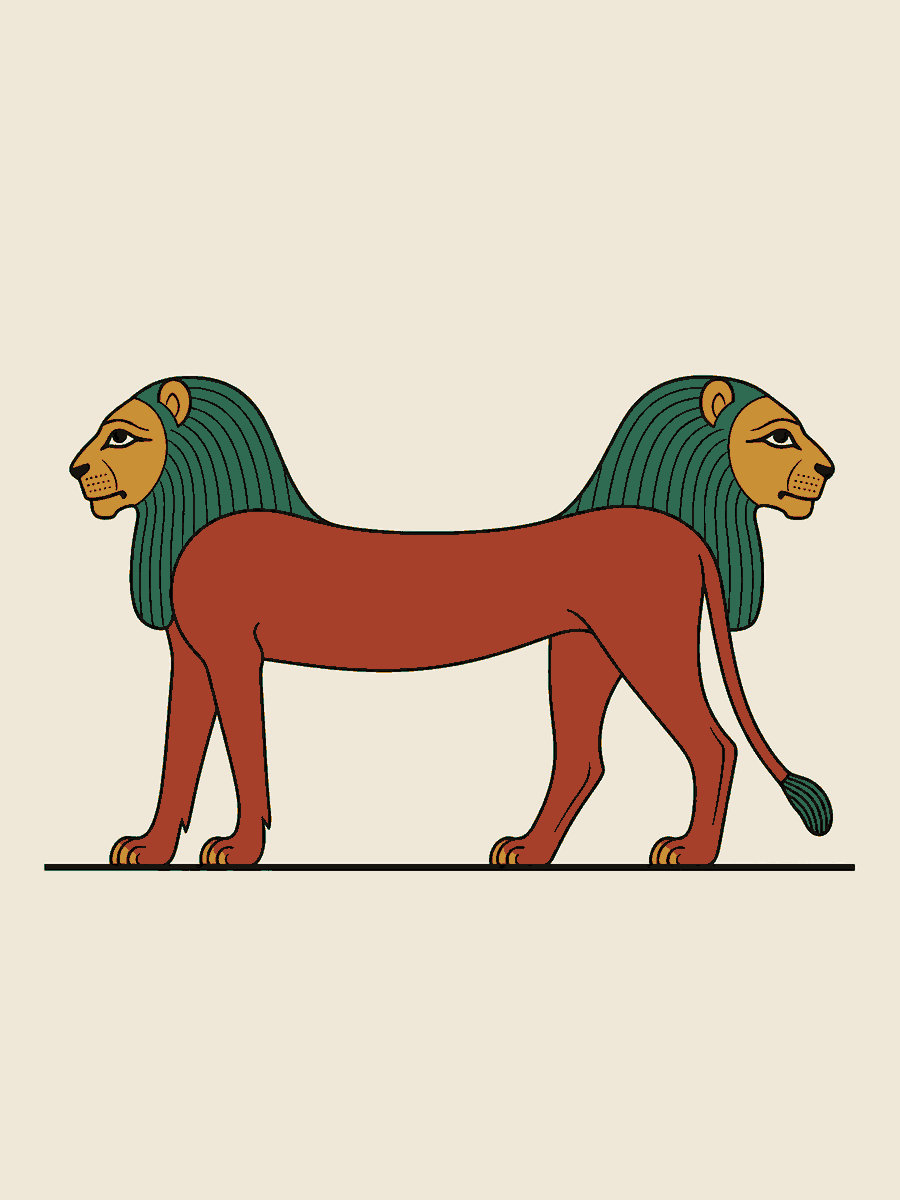
If you look Aker up anywhere else, you will meet a picture: two lions seated back to back, facing away from each other, with the sun rising between them. Often they are named Yesterday and Tomorrow.
It is a beautiful image, and it makes a real argument — the earth as a pair of horizons, the two places where the ground opens to let the sun in at night and out again in the morning. Aker as a doorway with a lion at each end.
I could not show you a source for it when this page was written. That has changed.
Maspero's 1894 edition of the pyramid inscriptions is now archived, and he says it plainly — Aker, "in his capacity as master of the two horizons and as a two-headed lion," may be regarded as "a soul in its own twins, a god in two persons."
So the lions are real, the two horizons are real, and Maspero adds the thing I would not have thought to ask for: the doubling is not two gods. It is one god existing as two — and he groups Aker with Shu-and-Tefnut and Geb-and-Nut as the same kind of being.
What is still unsourced is the pair of names you will see attached to those lions — Sef and Duau, "Yesterday" and "Tomorrow." Maspero gives the two lions and the two horizons. He does not give those names, and neither does anything else here. Budge calls Aker "double lion-headed," which is suggestive and is not the same statement.
Which is roughly the outcome you would hope for. The claim was marked as unchecked rather than repeated, and when the source turned up it confirmed most of it and left one piece — the two names — still hanging.
"Probably right" and "attested" are different things. Keeping them apart is most of the work, and the payoff is that when evidence arrives you can tell which part of what you believed was actually load-bearing.
No temple, and that is the point
Nobody worshipped Aker. There is no festival, no priesthood, no sanctuary.
That is not a sign he did not matter. It is a sign of what kind of god he was. Some Egyptian gods are addressed; some are simply how the world is described. You do not petition the ground. You just note, in passing, in a funeral text, that it has bones, and that on one particular night they were not steady.
Overview
Aker is the earth considered as a thing with a body — and specifically as a thing that can be frightened.
He earns his entry on a single half-line from one of the most extraordinary texts in Egyptian literature, where the earth's bones are said to tremble. The material is thin and the entry is graded accordingly, but what there is, is memorable.
Attestation history
Old Kingdom. Budge's Pyramid Texts god-list gives Aker (Unas 498, 614, Teta 309) [budge-1904] — three loci, two pyramids, Fifth and Sixth Dynasty. That is a securely early god.
The Cannibal Hymn. The substantive attestation is Unas 498, in the passage Budge titles "Unas, the Slayer and Eater of the Gods." He gives it both in interlinear transliteration and in a running rendering:
The sky poureth down rain, the stars tremble, the bow-bearers run about with hasty steps, the bones of Aker tremble, and those who are ministrants unto them betake themselves to flight when they see Unas rising [in the heavens] like a god who liveth upon his fathers and feedeth upon his mothers. [budge-1904]
The interlinear confirms the reading word by word: qes Aker — "the bones of Aker" — followed by ker-er-sen, "those beneath them" [budge-1904].
Verified against Maspero, 2026-07-30 — and the subject is plural
Budge cites Maspero for this line, and Maspero is now archived. The locus checks out: the Cannibal Hymn occupies Ounas ll. 496–525, so Unas 498 is correct.
But Maspero's French reads:
Le ciel fond en eau, les étoiles se battent, les sagittaires font leur ronde, les os des Akerou tremblent et leurs vassaux se sauvent [maspero-1894]
Les os des Akerou — the bones of the Akerou, a plural. Not one earth-god but a class of them, with vassals of their own ("leurs vassaux se sauvent").
Budge's own English preserves the plural and his commentary loses it. His translation reads "the bones of Aker tremble, and those who are ministrants unto them" — them, plural, referring back to a singular "Aker." Then his gloss converts it to "the great double lion-headed earth-god Aker," one being.
So the entry's open thread on singular Aker versus plural Akeru is answered for this passage at least: in the Cannibal Hymn the tremblers are plural. Whether the singular Aker of the two-horizons material and the plural Akerou of the Pyramid Texts are the same conception at different dates, or two things Budge merged, is now the live question.
Note this does not disturb the two-headed lion (C216): Maspero himself calls the singular Aker "lion à deux têtes." He uses both.
Budge's gloss names the form: "even the bones of the great double lion-headed earth-god Aker quake" [budge-1904].
What the texts say
The earth is given a skeleton. This is the whole reason to read him.
"The bones of Aker tremble" — or, following Maspero, "the bones of the Akerou" — is a stronger image than "the earth shook," and the difference is anatomical. An earthquake is a thing that happens to the ground. Bones trembling is a thing that happens inside a body — it is what fear does, and it is involuntary.
So the line is not describing a seismic event. It is describing the earth being afraid, in a body, from the inside.
What it is afraid of. The context matters and is not comfortable. The dead king Unas is rising into the sky as a god "who liveth upon his fathers and feedeth upon his mothers" — a king who hunts, kills and eats the gods in order to absorb their powers. Budge's summary: when Unas enters the sky, "all creation is smitten with terror. The sky dissolves in rain, the stars shake in their places, and even the bones of… Aker quake, and all the lesser powers of heaven flee in fear" [budge-1904].
Aker is in that passage as a measure. He is the most solid thing available — the ground itself — and he is listed to establish the scale of the terror. If the earth's bones are shaking, nothing is steady.
Budge takes the conquest literally. On the same passage he argues that Unas "is considered to have been a mighty conqueror upon earth, for those whom he has vanquished are beneath his feet," and adds "there is no reason why this statement should not be taken literally, and not as referring to the mere pictures of enemies which were sometimes painted on the cartonnage coverings of mummies" [budge-1904].
That is Budge arguing for a historical king behind a liturgical text, and it should be treated with suspicion — it is exactly the move his reputation rests on. Recorded here because it bears on how the passage is read, not endorsed.
Iconography
The archived sources give only Budge's phrase: "double lion-headed" [budge-1904].
Closed 2026-07-30 — Maspero supplies the double lion
This entry previously said the back-to-back lions were "the standard account" and "not in the archived material." Maspero 1894 is now archived and states it directly.
Discussing which god shares a scene with the king, he settles on Aker "lequel, en sa qualité de maître des deux horizons et de lion à deux têtes… peut être considéré comme une âme en ses deux jumeaux, un dieu en deux personnes" [maspero-1894].
In English: Aker, in his capacity as master of the two horizons and as a two-headed lion, may be considered a soul in its own twins, a god in two persons.
That gives the entry three things it lacked: the double lion form, the two horizons function, and — best of all — an explicit statement that the doubling is not two gods but one god existing as two. Maspero groups him with Shu-Tefnut and Geb-Nut as the same kind of paired-singular being.
The image is therefore: the earth as a pair of horizons, the sun passing between them, and the two lions being the places where the ground opens.
Still not sourced here: the names Sef and Duau, "Yesterday" and "Tomorrow," attached to the two lions. Maspero gives the doubling and the horizons; he does not give those names.
Cult and practice
Nothing. No temple, no festival, no priesthood appears in the archived sources, and it is likely there was none — Aker looks like a cosmological figure rather than a cult god, in the same class as nu.
The absence of a cult is not evidence of unimportance. It is evidence of what kind of god he is.
The record
Every claim above traces to a row here. Source, exact place in that source, and what it actually supports.
| Source | Locus | Attests |
|---|---|---|
[budge-1904] | *Gods of the Egyptians* I, Pyramid Texts god-list | **Aker (Unas 498, 614, Teta 309)** — three Old Kingdom loci |
[budge-1904] | *Gods of the Egyptians* I, Unas 498, interlinear | *qes Aker* — "the bones of Aker" — in the Cannibal Hymn |
[budge-1904] | *Gods of the Egyptians* I, gloss on the same | "the great double lion-headed earth-god Aker" |
Sources
[budge-1904]— Budge, The Gods of the Egyptians (1904), vol. I, ch. I and appendix. Public domain, archived. Budge caveat applies, and his literal-conqueror reading of the Cannibal Hymn is flagged above rather than followed.[maspero-1894]— Maspero, Les Inscriptions des Pyramides de Saqqarah (Paris, 1894), p. 67 l. 496 and p. 134 l. 319 — Budge's own citation for the hieroglyphic text. Not fetched.[maspero-1894]— Maspero, Les inscriptions des pyramides de Saqqarah (1894). French, with line numbers. Public domain, archived 2026-07-30. The edition Budge cites for his Unas/Teta/Pepi line numbers, so it is the right source for verifying them.[sethe-1908]— Sethe, Die altägyptischen Pyramidentexte. Fetched and unusable — printed hieroglyphs, OCR noise (C167).
Open questions
- ~~Establish the back-to-back lions from a source~~ — closed 2026-07-30 via Maspero: "maître des deux horizons et de lion à deux têtes… un dieu en deux personnes" [maspero-1894].
- The names Sef and Duau ("Yesterday" and "Tomorrow") remain unsourced. Maspero supplies the two lions and the two horizons but not those names. Determine whether they are attested or a modern synthesis.
- Pursue Maspero's grouping. He classes Aker with Shu-Tefnut and Geb-Nut as beings that are "un dieu en deux personnes" — a paired-singular category the corpus has not recognised as a category. If that holds it is a structural finding, not just a fact about Aker.
- Read Unas 614 and Teta 309 in Maspero — two of the three Old Kingdom loci are cited by Budge and never quoted, and they now decide whether the plural is general or peculiar to the Cannibal Hymn.
- ~~Determine the relationship between singular Aker and plural Akeru~~ — partly closed 2026-07-30. Maspero has Akerou, plural, with vassals, at the very line Budge glosses as a single god. The two forms coexist in Maspero, who also calls the singular Aker "lion à deux têtes."
- Now the sharper question: are they one conception or two? A plural class of earth-beings with dependants, and a singular two-headed lion who is master of the horizons, are not obviously the same thing. Budge merged them without argument. Test against the other Pyramid Text loci (Unas 614, Teta 309) — do those have singular or plural?
- ~~Get a modern translation of the Cannibal Hymn~~ — closed 2026-07-30 via Maspero, whose French differs from Budge's English on the crucial word. A genuinely modern rendering (Faulkner, Allen) would still be worth having and is in copyright.
- Establish whether Aker's role as the gate of the underworld — the sun entering the earth at one lion and leaving at the other — is attested, or inferred from the picture.
Cite this entry
Research grade: ◐partial — Genuinely attested, but the record is thin or single-period.
"Aker", The Egyptian God Corpus,
       graded partial, retrieved 2026-08-10.